Subterranean termite soil treatments in Gilbert, AZ address the primary structural wood-destroying organism found throughout the East Valley: Heterotermes aureus. Unlike drywood termites that live entirely within dry…
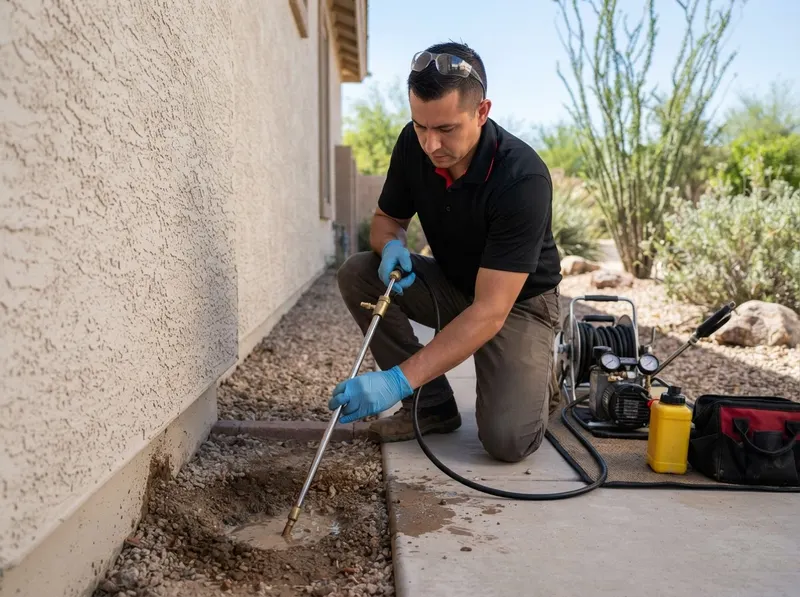
Subterranean termite soil treatments in Gilbert, AZ address the primary structural wood-destroying organism found throughout the East Valley: Heterotermes aureus. Unlike drywood termites that live entirely within dry framing, desert subterranean termites maintain subterranean parent colonies up to 10 feet below the surface, tunneling through damp ground beneath irrigated lawns in Power Ranch and Val Vista Lakes. When desert soils heat past 100 degrees Fahrenheit during summer monsoons, these pests locate foundation stem walls, ascending through monolithic foundation fissures, plumbing penetrations, and exterior stucco weep screeds via mud shelter tubes. Applying a continuous non-repellent termiticide creates a treated perimeter zone where foraging workers absorb active materials without detection, passing the chemical horizontally through the colony via grooming and mutual feeding until the nest collapses.
Selecting a continuous liquid barrier over exterior baiting systems provides immediate vertical control for structural concrete foundations. Plastic bait stations spaced 10 feet apart along landscape beds require months of random foraging encounters before colony delivery begins, leaving framing unprotected during active mud-tube construction. Liquid treatments apply a measured 4 gallons of solution per 10 linear feet into a calibrated 6-inch trench alongside stem walls, saturating the caliche foundation bed directly. If a property in Seville Golf and Country Club or Morrison Ranch features exterior pavers, flagstone patios, or attached garage slabs, technicians drill small 0.5-inch ports into concrete expansion joints at 12-inch intervals to reach the concealed sub-slab fill beneath, sealing every injection site flush with polymer-modified hydraulic cement afterward.
Local architectural standards dictate exact treatment depths throughout Agritopia, Layton Lakes, Coronado Ranch, and The Islands. Heavy drip irrigation along stucco foundations accelerates chemical degradation in generic, over-diluted barrier sprays. Continuous non-repellent applications bind chemically to dry clay and silt particles, resisting leaching caused by localized landscape watering systems and seasonal washouts near the Riparian Preserve at Water Ranch. The practical trade-off between exterior soil trenching and interior sub-slab drilling centers on accessibility versus disruption: exterior soil trenching requires no interior structural disturbance, whereas homes with slab settlement cracking or interior plumbing penetrations require localized interior tile or carpet lifting to treat the entire structural footprint.
Every job gets a firm, written price after a free on-site visit.
Tell us about your subterranean termite soil treatments job in Gilbert and we'll send a clear, written quote, usually the same day.
 Saguaro Trail Pest Control